

How Does Foundation Repair Work and Can It Really Fix Serious Foundation Problems?
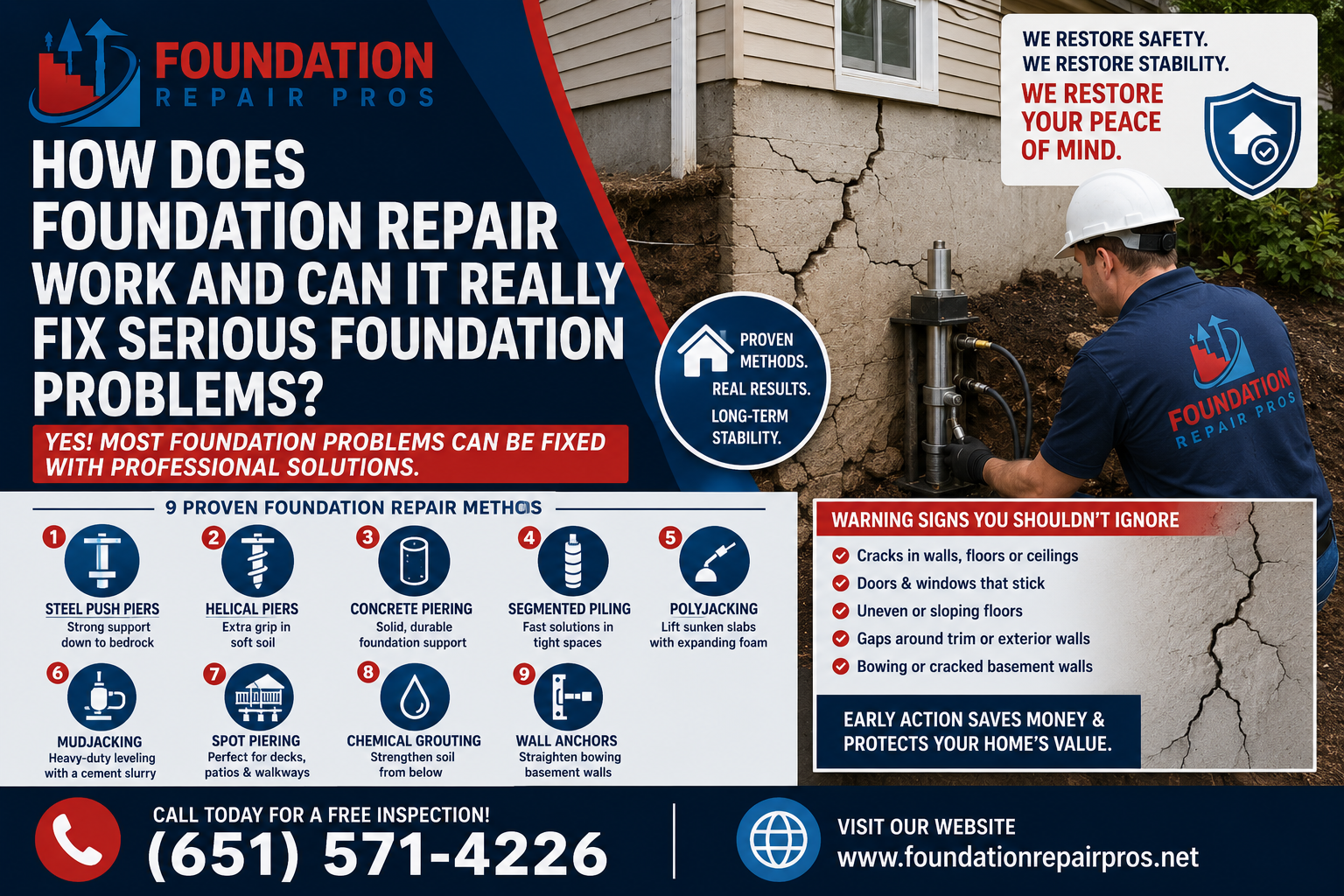
Summary: This blog explains how foundation repair works in simple terms and reassures homeowners that most structural issues can be fixed with professional help. It describes common warning signs, repair methods, and why DIY fixes are risky. The content highlights that early action and expert solutions can restore safety, stability, and long-term value to a home.
Finding out your home has a shaky base feels scary, but we are here to tell you that your house is not lost! Most people worry that a few cracks mean the end, but the truth is that professional help can make your home stronger than ever before. Understanding how does foundation repair work It is the first step toward peace of mind and a safe, level living space for your family.
Your Home’s Foundation Can Be Saved, and Here Is Why
The most important thing to know is that almost every foundation problem has a solution. We see homes every day that look like they are falling apart, but with the right tools, we bring them back to life. Think of your foundation like the bones of your house; even if a bone is hurt, a doctor can set it right so it heals properly. Our team uses modern technology to stop the house from sinking and lift it back to where it belongs.
1. Using Steel Push Piers to Support Your Weight
This is one of the most common ways we help houses that are sinking. We use very strong steel tubes and push them deep into the ground using a hydraulic machine. These tubes go down until they hit solid rock or very hard dirt that won't move. Once they are in place, the weight of your house sits on these steel stilts instead of the soft mud. This is a great way to ensure the building stays level forever.
2. Helical Piers for Extra Grip in Soft Soil
If the ground around your home is very sandy or wet, we use helical piers. These look like giant metal screws. Instead of just pushing them down, we twist them into the earth. The "threads" on the screw help it stay anchored so it doesn't move up or down. This method is perfect for lighter structures like porches or for homes built on very loose soil.
3. Concrete Piering for a Solid Base
Concrete is a classic choice for repairing foundation issues because it is incredibly strong and doesn't rust. We dig deep holes and place pre-hardened concrete cylinders into the ground. We use a jack to push them down one by one until they can't go any further. This creates a vertical pillar of stone under your home that provides massive support for heavy brick houses.
4. Segmented Piling for Fast Solutions
Sometimes we use smaller pieces of concrete that fit together like building blocks. These are called segmented piles. We drive them into the dirt directly under your foundation wall. Because the pieces are small, we can do this work in tight spaces where big machines can’t fit. It is a very smart way to fix foundation issues without tearing up your entire yard.
5. Polyjacking to Lift Sunken Concrete Slabs
If your garage floor or driveway is sinking, we don't always need big metal poles. Instead, we use "polyjacking." We drill tiny holes in the concrete and pump in a special foam. This foam expands like a giant sponge and pushes the heavy concrete slab back up to the right height. The foam is waterproof, so it won't wash away when it rains.
6. Mudjacking for Heavy-Duty Leveling
This is a traditional method similar to polyjacking, but we use a "slurry" which is a mix of mud, cement, and sand. We pump this thick liquid under your foundation to fill up any empty gaps. As the mixture hardens, it becomes as solid as a rock. This is a very cost-effective way to support a basement floor that has started to dip in the middle.
7. Spot Piering for Your Decks and Patios
Not every job involves the whole house. Sometimes it is just your back porch or a walkway that is tilting. For these smaller jobs, we use spot piers. We dig holes by hand at the corners of the structure and fill them with fresh concrete. This gives the smaller parts of your home a steady place to rest without needing the heavy machines used for the main house.
8. Chemical Grouting to Tighten the Soil
In some cases, the problem isn't the house, but the dirt itself. We can inject special eco-friendly chemicals into the ground that turn loose sand into a hard, glue-like substance. This makes the earth under your home much stronger. It is a "no-dig" solution that helps prevent the house from moving before big cracks even start to show up.
9. Foundation Wall Anchors for Bowing Walls
If your basement walls are starting to curve inward, we use wall anchors. We place a metal plate on the inside of the wall and an anchor in the yard outside. A long steel rod connects them. By tightening the bolt, we slowly pull the wall back into a straight line. This prevents the wall from collapsing and keeps your basement safe and dry.
Can Foundation Issues Be Fixed Once They Get Serious?
Yes, foundation issues can be fixed. It is a question we hear often. Even if your house looks tilted or has huge gaps, these methods can bring it back. Foundation Repair Pros uses these high-tech systems to make sure you feel safe in your home again. While you might wonder how to fix foundation problems yourself, it is always best to let us handle the heavy lifting to ensure your home stays stable for years to come.
Frequently Asked Questions
How long does it take for the foundation repair to dry or set?
Most piering is instant, but concrete patches or mudjacking usually need about 24 to 48 hours to fully cure.
Will my doors start working again after the foundation is lifted?
Yes, once we level the house, most doors and windows that were stuck will pop right back into place.
Does foundation repair create a big mess in my yard?
We try to keep things very clean, though some digging is required to reach the bottom of your house.
Is the foam used in polyjacking safe for the environment?
The foam we use is specially designed to be safe for the soil and won't leak any bad chemicals into your yard.
Can I stay inside my house while the repairs are happening?
Absolutely, you can go about your day normally while we work on the outside to stabilize your home.